About
Journal Summary
The journal focuses on publishing high-quality research that advances in the field of horticulture and agricultural sciences. It covers a broad range of topics, including innovative horticultural practices, plant physiology, genetics, pest and disease management, sustainable agriculture, animal husbandry, and veterinary sciences. The journal welcomes studies on advanced technologies, such as precision agriculture, biotechnology, animal sciences, and smart farming, as well as research on climate change adaptation and water management in horticulture. In addition, it emphasizes the importance of post-harvest management, soil health, plant nutrition, and animal sciences. It also explores the socio-economic and policy aspects of horticulture, addressing challenges related to market trends, food security, and rural development
Editor-in-Chief: Dr. Niaz Ahmed Wahocho
Format: Print & Online
Frequency: Bi-Annual 2 Issues
Language: English
Author Fees: Yes
Types of Journal: Academic/Scholarly Journal
Access: Open Access
Policy: Double blind peer-reviewed
Review Time: 08-10 weeks approximately
Current IssueVol 3, No 1 (2026): Journal of Horticulture and Agricultural Sciences (JHAS)
Published March 20, 2026
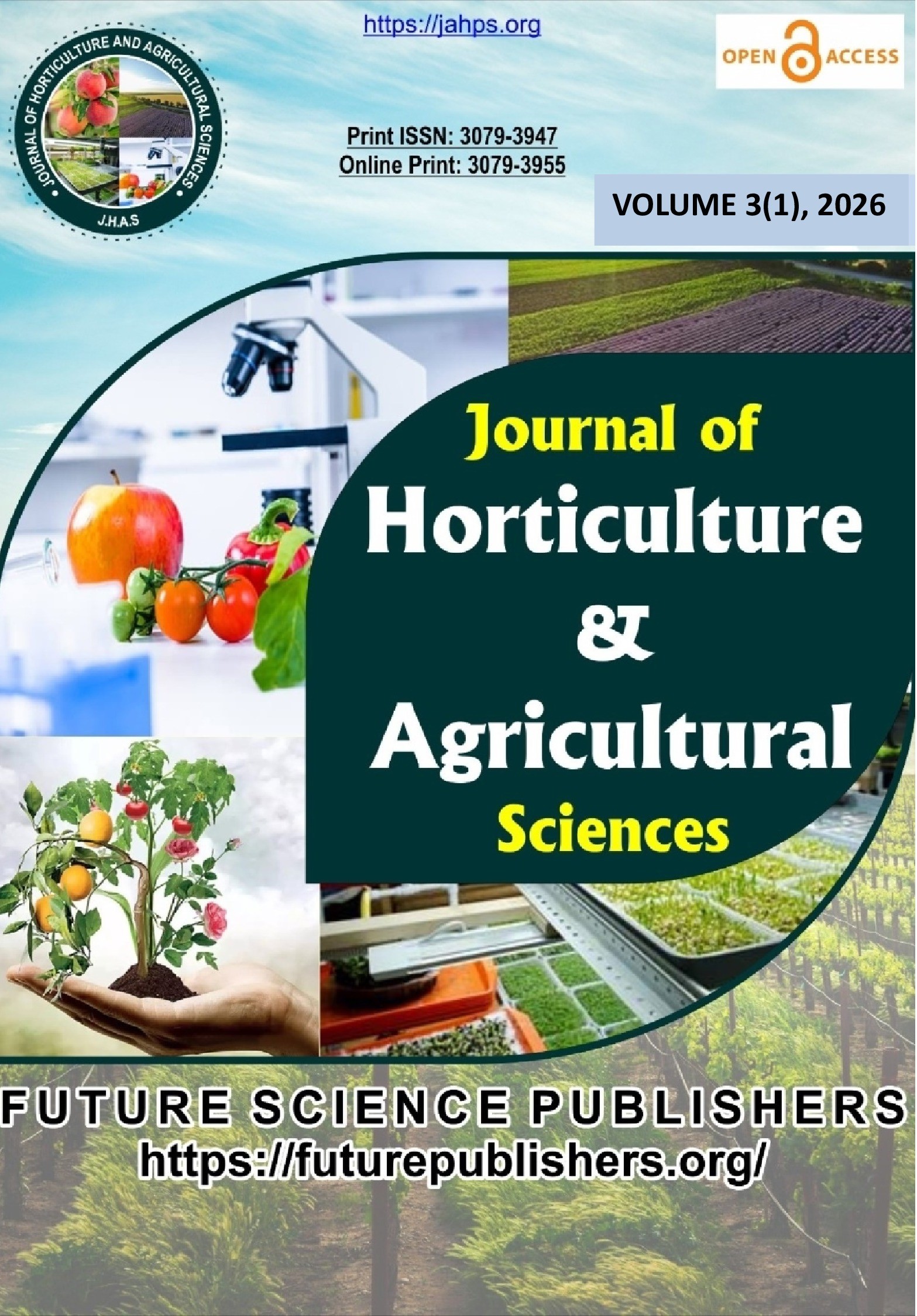
Table of Contents
Articles
Peer Review Policy
The Journal of Horticulture and Agriculture Sciences (JHAS) follows a rigorous, transparent, and ethical peer-review process to ensure the publication of high-quality, original research in the fields of agricultural productivity, crop management, and horticultural innovation. As an open-access journal, JHAS is committed to timely, unbiased, and confidential manuscript evaluation in line with international best practices and COPE Guidelines.
The Step-by-Step Review Process
1. Manuscript Submission
Authors submit manuscripts via the JHAS online portal, ensuring all technical parameters and statistical data are formatted according to the journal’s specific guidelines.
2. Initial Editorial Screening
The editorial team evaluates the submission for:
- Scope: Relevance to horticulture, agricultural sustainability and soil sciences.
- Originality: Evidence of a novel contribution to agricultural knowledge.
- Formatting & Compliance: Adherence to technical reporting standards (e.g., reporting Min-Max ranges in tables).
- Plagiarism Screening: All manuscripts are checked using Turnitin or equivalent industry-standard software.
Manuscripts failing this stage may be returned for technical revision or desk-rejected.
3. Double-Blind Peer Review
- Manuscripts passing the initial screen are assigned to at least two independent subject-matter experts.
- Anonymity: Reviewers remain anonymous to authors, and vice versa, to ensure an unbiased assessment.
- Reviewer Assessment Criteria:
- Scientific Rigor: Methodology, field experiment design, and statistical data analysis (e.g., PCA or ANOVA).
- Impact: Practical application of findings for the agricultural community.
- Clarity: Coherence of logical interpretation and structural flow.
- Ethical Compliance: Proper citation integrity and data authenticity.
4. Editorial Decision
The Editor-in-Chief, in consultation with the Editorial Board, evaluates the reviewer reports and issues one of the following decisions:
- Accept: Meets all quality, technical, and ethical standards.
- Minor/Major Revision: Requires specific author modifications and data clarification before reconsideration.
- Reject: Does not meet the required scientific threshold or ethical standards of JHAS.
5. Revision & Resubmission
Authors must provide a point-by-point response addressing all reviewer and editor comments. Revised manuscripts may undergo a second round of review, typically by the original reviewers, to verify that technical concerns have been addressed.
6. Final Decision & Publication
Upon final approval by the Editor-in-Chief, accepted manuscripts proceed to professional copyediting, layout formatting, and digital publication.
Commitment to Ethical Review
- Confidentiality: All research data and manuscript content are handled with strict confidentiality.
- Fair Evaluation: Decisions are based purely on academic and scientific merit, free from commercial or personal bias.
- Reviewer Integrity: Reviewers must disclose any conflicts of interest and adhere to the highest ethical standards of peer review.
- Timely Processing: JHAS strives to complete the initial peer-review cycle within 4–6 weeks to support the rapid dissemination of agricultural findings.
JHAS maintains the highest standards of integrity to ensure future eligibility and compliance with international indexing requirements, including DOAJ, Scopus, and Web of Science.
REVIEWER GUIDELINES
At the Journal of Horticulture and Agriculture Sciences (JHAS), we believe that rigorous peer review is the cornerstone of advancing agricultural innovation and maintaining the integrity of horticultural research. These guidelines are designed for reviewers participating in our double-blind peer review process. All submitted manuscripts, including original research, reviews, and technical notes, undergo a comprehensive evaluation before publication.
Double-Blind Peer Review Process
JHAS adheres to a double-blind review model to ensure the highest standards of objectivity:
- Anonymity: Both reviewers and authors remain anonymous throughout the process to prevent bias.
- Merit-Based Evaluation: Manuscripts are assessed strictly on their scientific merit, originality, technical accuracy, and relevance to the global and regional agricultural landscape.
Role and Responsibilities of Reviewers
Reviewers serve as expert advisors to the Editorial Board, providing critical recommendations on whether a manuscript should be accepted, revised, or rejected. Key responsibilities include:
- Assessing Scientific Rigor: Evaluating the experimental design, field/laboratory methodology, statistical analysis (e.g., use of PCA, ANOVA, or specialized R scripts), and the logical flow of conclusions.
- Evaluating Parameter Accuracy: Ensuring that exact terms and units (e.g., Plant height cm) are used correctly and that results are interpreted with statistical significance.
- Providing Constructive Feedback: Offering clear, professional, and actionable insights to help authors improve their work, regardless of the final recommendation.
- Ensuring Scholarly Context: Identifying missed citations or relevant recent studies that could strengthen the manuscript’s background.
- Maintaining Confidentiality: Treating all submitted data, images, and text as privileged information that must not be shared or used before publication.
- Declaring Conflicts of Interest: Disclosing any personal, professional, or financial competing interests to the Editorial Office before accepting a review invitation.
Guidelines for Submitting Review Comments
Reviewers are requested to access the JHAS e-submission portal to download the manuscript and any associated supplementary data sheets.
- Focus on Logic: While minor language issues are secondary, reviewers should focus on the logical interpretation of results and the validity of the research findings.
- Data Presentation: Evaluate whether tables and figures clearly illustrate the ranges (minimum/maximum) and trends observed in the study.
- Final Decision: While reviewers provide a recommendation (Accept, Minor Revision, Major Revision, or Reject), the Final Decision rests with the JHAS Editorial Board
PRIVACY STATEMENT
The Journal of Horticulture and Agriculture Sciences (JHAS) is committed to protecting the privacy and personal data of its contributors and users. The names, institutional affiliations, email addresses, and any other personal information entered on this journal site will be used exclusively for the stated purposes of this journal. These purposes include:
- Editorial Communication: Facilitating the peer-review process and correspondence between authors, editors, and reviewers.
- Manuscript Processing: Managing the technical workflow from submission to final decision.
- Publication-Related Updates: Informing users of published content, calls for papers, and relevant academic announcements.
This information will not be shared with third parties or used for any other commercial purpose without the explicit consent of the individual, except as strictly required by law.
By submitting their details or manuscripts, users acknowledge and consent to the collection and use of their information in accordance with this Privacy Policy. JHAS remains dedicated to maintaining the integrity of the academic record while ensuring the highest standards of data confidentiality for the agricultural and horticultural research community